

You probably have your own personal triage system for the newsletters that come into your inbox that you choose not to read. Mine starts, I suppose, with a certain diminutive ex-Secretary of Labor and moves on from there to cover just everybody from what I think of as an utterly-predictable left.
There are rightists too who are high on my ‘do not read’ list, but the rightists usually have the virtue of being deranged and thus somewhat interestingly unexpected. The leftists of this category are never crazy exactly. They are sane but what they have to say comes out as totemic as a snare drum. The point always is that the world has been in moral decline since Ronald Reagan and gets worse by the minute, that the way forward is for power to devolve, to be restored to some kind of workers’ council or other, and for government to systematically break the back of Bigness wherever it can be found.
I had always had a certain tolerance for this — it seemed like the kind of irritating-but-inarguably-good-thing of the same category as the Sermon on the Mount or a public service announcement reminding you to eat your greens. My feeling was that the world’s original sin is inequality; and any movement advocating for equality — which is the core of the left — will always be valid, even if it will always be something of a lost cause.
But recently I have had a change of heart. I’ve begun to notice how much the left serves as the conscience of anybody on the liberal side of the aisle, but that appearance of conscience is based on almost nothing at all and stands in the way of pragmatism. When I do my semi-regular roundup of news, I am always careful to read The Nation, Jacobin, The New Left Review, Grist and — trust me — I have found nothing at all worth following up on in any of them.
The problem is structural. It’s like watching somebody slowly drowning and, instead of trying to save themselves, focusing on drowning with dignity, or ensuring that they have the last word just before they drown. The tone is always wistful and reactive. The great deeds always occurred in some misty past — they seem to run from The Nation’s founding by abolitionists in 18651 to Eugene Debs’ arrests to the New Deal to the SNCC sit-in in Greensboro. The sense — certainly in reading The Nation, but to a surprising extent with something like Jacobin as well — is of reading the most reactionary, most venerable publication in existence. There is the revealed wisdom as it emerged somewhere between the sans-culottes and the Communards and the sole real political obligation is to honor that sensibility. Once ensconced in that position, the only editorial obligation is to lament and to complain — everything is fallen, always, there is a truth, the shiny gold object of Theory but it’s been so trammeled under by market capitalism, and neo-imperialism, and liberal hypocrisy, and conservative avarice, that there is barely any attempt to point out the true way, just to rail against the trammelers.
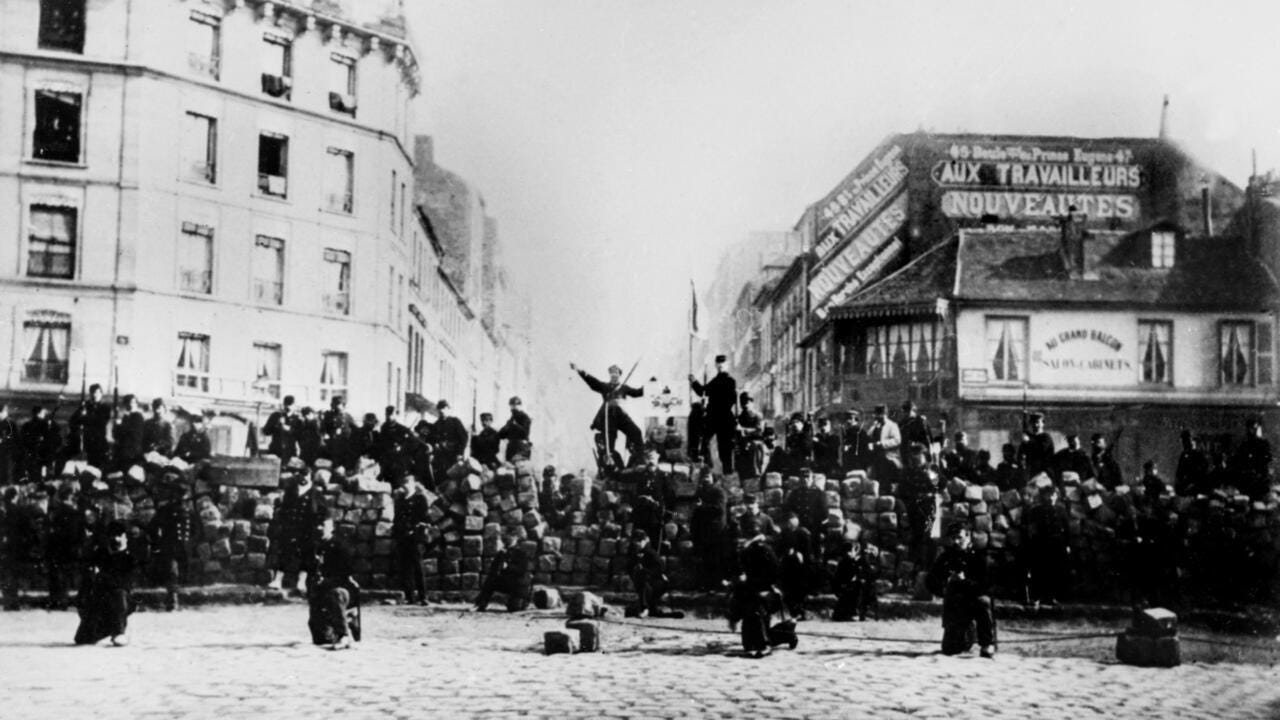
I used to think that this was all pretty harmless until I realized that it wasn’t, that in its incessant effort to seize the moral high ground, to be the conscience prick for people actually trying to do stuff, the left had been a deleterious and baleful influence. This argument is neatly contained in Marc Dunkelman’s Why Nothing Works, which is really a history of an ideological split running between what we can call liberals and progressives. Dunkelman’s preferred phraseology is Hamiltonians and Jeffersonians — a framing that has the virtue of bringing the debate back to the beginnings of American history but also confines a much wider phenomenon to an American context. Hamiltonians, in essence, want to centralize power, they want to build up institutions that can serve the public good and at the same time act, in John Kenneth Galbraith’s phrase, as “countervailing power” to private special interests, trusts, corporations, et al. The Jeffersonian impulse is suspicious of power in toto and wants power to devolve back to the people, in a pastoral vision. The problem with the Jeffersonian impulse is that it never actually works — power is a fact and it tends to centralize, and no amount of wishing that away will create a new pastoral utopia of self-reliant yeoman farmers — but it does have a certain effectiveness in gumming up the works for people who are actually are trying to make power function. The villain of Dunkelman’s narrative is the New Left of the ‘60s, which never really achieved power, which always presented itself as a brave resistance movement, but actually did have a great deal of political influence — creating so many regulatory hurdles and loci of ‘principled resistance’ that those who were trying to develop administrative efficacy of any sort in the end simply threw their hands up and let themselves be bound by red tape. The story that Dunkelman tells is of liberalism tearing itself apart, with the Hamiltonian forces of reform finding themselves ultimately canceled out by the Jeffersonian dedication to the will of the people, even if the people ended up being deeply divided and obstreperous. “The [progressive] movement’s previous inclination to build power up had been replaced by an almost insatiable desire to tear things down,” Dunkelman writes.
What Dunkelman’s book did for me is to break the spell of a particular shibboleth — that the left and liberals work in tandem, that the left may be impractical but it is at least an honest conscience pointing towards a worthy aim. And that aim is understood always to be some variation of communism, or socialism, with all the bad bits taken out. But the problem with communism is not that it works in theory but is soiled by the cruel world. The problem is that it doesn’t work in theory. It has an inadequate psychological understanding of power. It assumes a form of collective action and then a centralized entity which will act benevolently in accordance with the ‘general will,’ but collective action is never really achievable — human beings are too tangled for that — and it is beyond naive to imagine that any centralized entity, given unrestricted power, will act with perfect benevolence. The state ‘withering away’ really isn’t very high level political science. The New Left isn’t necessarily wedded to Marxism, but it is tied to collective action — to these myths of moments of glorious revolution and solidarity, of the people all united together. It’s no accident that, during Covid, the left became the most strenuous enforcers of mask mandates, and, during the Woke peak, of speech censorship: something about that collective action was irresistible. Unfortunately, that kind of unity will never actually emerge from the people — only, occasionally, from those in power imposing some kind of fiat — and that means that the core project of the left is, and always will be, a pipe dream. What the left tends to dedicate itself to, instead, is a principled opposition to anything that falls short of these goals of perfect collectivity and egalitarianism. Liberals have let themselves be tied to the left out of a kind of shared nostalgia for the ‘60s or for, who knows what, the Sacco and Venzetti trial or something, but it’s time to cut the cord. The left is consistently an albatross on liberal politics — Democrats’ leftward pull during the Woke era became the perfect campaign target for Trump — and liberals never seem to learn from the mistake. The left is incoherent and fanatical in its incoherence. It’s time for liberals to see that and to focus on being the group that’s actually trying to get things done.
Which, by the way, I just noticed this, seems a little late to get in the abolitionist game, no?
Hard to argue with your final lines, given the last decade: "The left is incoherent and fanatical in its incoherence. It’s time for liberals to see that and to focus on being the group that’s actually trying to get things done."
It's a target-rich environment for Sister Souljah moments. The next Democrat with the balls for it will clean up.