

ANDREY MIR’s Digital Reversals, 2025
Holy shit, this is a great book. I’d been somewhat aware of Mir — he’s on this platform, I think I rejected an article of his once — but I wasn’t ready for the distilled brilliance of this book, which seems to contain something like the cheat code for modernity and also, by the way, may be the most depressing book I’ve ever read.
To deflate Mir slightly, he is standing on the shoulders of giants — specifically, one giant, Marshall McLuhan — and in McLuhanite fashion is ‘extending’ McLuhan’s arguments into the era of social media and AI.
I’ve read some of McLuhan, and felt like I got what I read, but I hadn’t gone into the deeper waters of Understanding Media: The Extension of Man and what that is is truly a paradigm-changing understanding of how the world works. The point is that tools become an extension of ourselves out into the world — we take something we are already doing and construct the extension of that, and then, as the McLuhan-esque saying has it, “We make our tools and then our tools make us.” Once we are in this dynamic of techne, two all-but-mathematical laws take over. One is the “technological imperative” — i.e. that, as Mir summarizes it, “the nature of any technology is to perfect its performance until it reaches its full potential.” And the other is the “reversal,” the notion that when a form peaks it reverses. It doesn’t go back to what it was before — nothing goes backwards — but becomes, as Mir phrases it, a “funhouse mirror where each reflection accelerates and introduces a new distortion of the opposite.”
To understand Mir’s argument, you do have to understand what is meant by a reversal. The simplest example is that a car is an extension of the human interest in transportation. A car moves faster and achieves speed. Once you have enough cars, you achieve the reversal, which is traffic — so many cars boxing each other out and contributing to stasis. In Mir’s telling, media ecologists enjoy an — actually quite fun-sounding — parlor game of ‘tetrads’ where they produce reversals (as well as ‘retrievals’ and ‘obsolescences’ for different technologies). For instance, the reversal of money is credit, which is not money at all, and the reversal of a phone camera is surveillance and information overload.
All of this is, basically, within McLuhan’s domain and seems hard to argue with — what’s being described are ‘properties’ of technology. But McLuhan didn’t live long enough to see the advent of social media or AI, and Mir nicely fills in the gaps, covering what has happened. And, essentially, the decade of social media has reversed the entire half-century of printed reading — what McLuhan calls “the Gutenberg Galaxy” if not the 3,000 year advent of literacy itself. If the ‘axial age’ — in Karl Jaspers’ coinage — produced the civilization we have, rooted in its respect for the written word, we have just lived through the ‘axial decade’ where that has been effectively obliterated.
Mir has abundant examples for why this happened. The most obvious, and most significant, is the replacement of long-form, ‘disembodied’ text with short-form text, as in texting or twitting, that mimics speech — often very directly. Caps lock means shouting, ‘lol’ means laughing, and the emoticons carry out a replica of speech. That revolution — in which figures are embodied in social situations, exactly like in real life — produces the same dynamics as a pre-literate society, which Mir summarizes as “storytelling, social grooming, and quarrel.” What is eliminated is persuasion through logic, the sense of reciprocity and mutual respect that comes from literate disembodiedness, and “cognitive delay” in making decisions, the latter of which, Mir points out, is really the thing that enables civilization.
In the head-spinning reversals of the Axial Decade, we have experienced, among others, the following: old news media reverses from news supply to news validation. The actual work of first-hand reporting isn’t so much done by intrepid journalists reaching a story as by the crowd gathered around with cell phones, illuminating an event from all possible angles, and with the journalists decreeing which events are worthy of coverage and which angles of coverage are acceptable. Then, the “viral editor” becomes the “viral inquisitor.” The “viral editor” is an important concept for Mir, the ability of the online mob to upvote content that it finds compelling. At some point in the 2010s, the viral editor reverses — right on schedule really for McLuhanite analysis — into the “viral inquisitor,” which interrogates and shames anyone online who falls afoul of the opinion of the ‘viral editor.’ This mechanism, Mir notes, also produces a ‘retrieval’ of the honor code of pre-literate societies where justice is determined not through recorded law but through complicated social matrices of honor and shame. Meanwhile, “the picture of the world in the media reversed from pride to shame,” as Mir puts it, with the sunny optimistic view of inexorable global progress that held sway as late as the first Obama administration switching, by the second term, into ‘original sin’ and decay. Journalism, meanwhile, reverses from attempts to depict the world ‘objectively’ into “post-journalism,” describing the world as it should be once social justice is achieved.
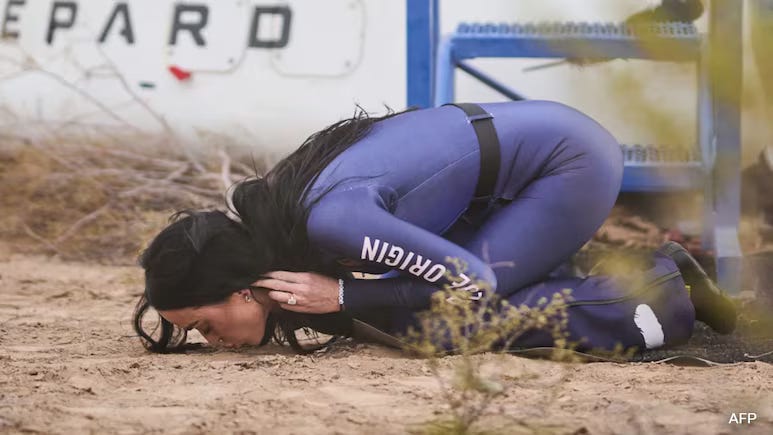
That’s of course not all of it. With the reversals of the Axial Decade, and the forfeiture of cognitive delay, we face the “demise of planning and time management on a generational scale.” And our emotional life itself reverts to a pre-literate structure. Mir has a certain amount of fun with Katy Perry kissing the earth after 11 minutes in outer space — the point is that she would not have done so if cameras had not been rolling. Feeling, as an internal emotional event, is replaced with “intensity,” as a socially circumscribed simulacrum of feeling.
If many of the ills of the social media change feel familiar, what is different is the diagnosis, and, in a word, it’s terminal. My working assumption had been that, difficult as the social media age has been, the technology gradually matures and with that some of the worst excesses evaporate away and meaningful content is achieved (like with this platform). That’s been kind of my battle standard, encapsulated in Martin Gurri’s line “we are caught between an old world which is decreasingly able to sustain us intellectually and spiritually, maybe even materially, and a new world that has not yet been born,” with that birth something to look forward to maybe in my lifetime. Mir and Gurri are linked together. Mir quotes Gurri describing him as “my intellectual doppelgänger,” but Mir is Hyde to Gurri’s Dr. Jekyll, and he parts company with him on this point with the sorrowful line, “As dear as Martin as to me, dearer still is media ecology.” And Mir’s uncompromising vision is pretty compelling. If he is in agreement about the notion of a rupture in world affairs from the era of mass media (one-way communication) to that of the internet (two-way or proliferating communication), the “technological imperative” still has its hold. Digital media has hardly peaked and the turn towards pre-literacy, with all the moral and political connotations that entails, will likely continue for some time. And not only that, but, as Mir writes, “digital media is a Petri dish for emergent non-human intelligence” and all the flattening characteristics of the digital media era will carry over into AI. If some reversal is inevitable, we can’t hope for a return to what was but rather a funhouse mirror reflection of the worst tendencies of the new technology.
So if this is one of the best books I’ve ever read it’s also maybe the most depressing. There really is no way back and even abstinence is unavailing. As McLuhan said to W. H. Auden, who was proud of not owning a television, “You merely suffer the consequences of TV without enjoying it.” There’s no reason to expect any exemption from the technological imperative, and Mir’s somewhat surprising recommendation is just to give in to it, and to open Pandora’s Box since it’s going to be opened anyway. I’m not sure that that’s a much sunnier view than McLuhan’s longing for the apocalypse, but Mir seems serious about it. The technological imperative carries all before it, and the reversals are only going to get faster and more jarring. I have had the sense of my life being basically the experience of watching my own obsolescence — as culture gets obviated in the midst of the reversals — and Mir, to his credit, explains why that is and why that can’t really be avoided. “Awareness,” he writes — proposing maybe the mother of all consolation prizes — “brings at least the fun of observation.”