

Dear Friends,
The best news of the year so far is my uncle Larry Kahn starting his Substack 27 Ways to Leave Your Sovereign. Larry may well be the funniest person I’ve ever met, as well as one of the very smartest. It’s exciting for me to see him get Substack-pilled and really look forward to what he’ll write.
I’m committing myself to putting out one of these news roundups at the start of every month and was kind of racking my brains for what to write about during the slow holiday period when a U.S. helicopter descended into a completely different country and picked up the president of that country and carried him off to a prison in the U.S. leaving that country currently without a ruler but also, maybe, being ruled by the U.S.
To be honest, the best takes I’ve seen so far on the Venezuela news are both published by Persuasion, my employer. Quico Toro, a really great Venezuelan journalist, chronicles the deep ambivalence that Venezuelans have towards the raid. “Along with his powerbroker wife, Cilia Flores, Maduro belongs in a prison cell as surely as anyone I can think of,” writes Toro. “Which is why you’ll be hard pressed to find a Venezuelan who doesn’t, on some level, rejoice at last night’s news.” But that’s deeply tempered by Trump’s evident lack of follow-through. As Toro writes on his own Substack, it’s a bit ominous that nobody in Caracas is celebrating — Venezuelans have to come to have a jaded view of their own political fortunes (“the most trustworthy principle for interpreting Venezuelan affairs has been a simple heuristic: whatever outcome makes Venezuelans’ lives most miserable is always to be treated as the odds-on-favorite,” Toro writes) —and that may well be an astute intuition. If the regime is left in place, its tendency would be to clamp down harder on the power it has. “In the menu of awful options ahead of us, leaving this chavista rump in charge of the country seems like the worst option,” Toro writes.
Meanwhile, the legendary Francis Fukuyama argues that there is a delicate path towards nation-building. It involves restoring Venezuela to its long-standing democratic traditions and easing the path to power of Edmundo González and María Corina Machado, the opposition leaders who have a degree of legitimacy from González’s evident victory in the stolen 2024 election. But that requires care and patience, none of which are exactly The Donald’s strong suit, and in the morning hangover after yesterday’s euphoria, we’re starting to get a sense of what’s to come.
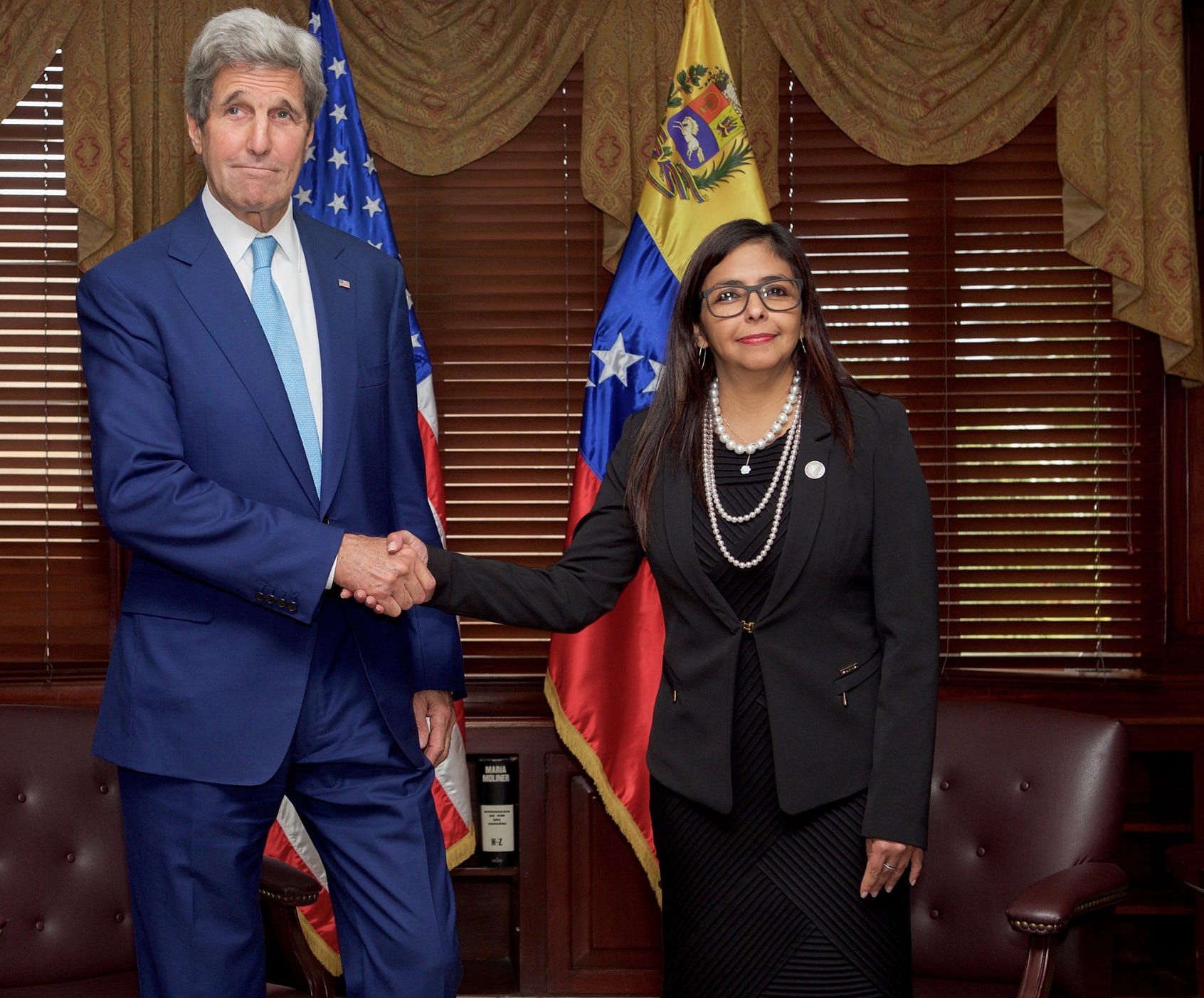
Trump’s interest clearly extends to favorable publicity, which he has already achieved from the raid; to oil; and to the repatriation of Venezuelan migrants. He seems likely to get what he wants from the chavista rump regime — The New York Times reports that Trump officials believe they can work “at a much more professional level’ with Vice President Delcy Rodríguez than they could with Maduro, and Trump’s offhanded statement at the press conference that Machado is “a very nice woman but doesn’t have the respect or the support within Venezuela to be the leader” basically puts to rest any possibility of an heroic attempt by the U.S. to genuinely liberate Venezuela from Chavismo. As Anne Applebaum put it on The Atlantic’s podcast, “it was a war or military action designed for US domestic political consumption rather than to achieve something in Venezuela.” Assuming that Rodríguez plays ball, what might be expected is oil and the re-dumping of migrants back to Venezuela — which seems really to have been what got Trump interested in Venezuela in the first place. The idea that the U.S. can extract a world leader from his bedroom at any time does send a powerful message — and may shift Venezuela more in the direction of being the sort of U.S. protectorate that Cuba was in the early part of the 20th century.
With the raid something like a “Trump Doctrine” comes more into focus. It’s always felt a bit silly to talk about political science terminology like ‘doctrine’ when what’s basically dictating U.S. foreign policy is Trump’s attention span, but Trump did actually spell it out in the 2025 National Security Strategy. This is how the NSS put it:
We want to ensure that the Western Hemisphere remains reasonably stable and well-governed enough to prevent and discourage mass migration to the United States; we want a Hemisphere whose governments cooperate with us against narco-terrorists, cartels, and other transnational criminal organizations; we want a Hemisphere that remains free of hostile foreign incursion or ownership of key assets, and that supports critical supply chains; and we want to ensure our continued access to key strategic locations. In other words, we will assert and enforce a “Trump Corollary” to the Monroe Doctrine.
What comes through — and it now seems like Trump means it — is a hemispheric approach to world politics. If the great foreign policy debate has been between the vision of a rules-based order and the Pax Americana where the U.S. radiates power wherever it wishes, Trump seems to have produced a new structure in which the U.S. does whatever it wants in the Americas but largely leaves the rest of the world to the devices of whichever great power has control in the relevant region. The ominous line in the NSS is the Trump administration calling for “strategic stability” with Russia, which means non-interference. As Foreign Policy puts it, with the Venezuela raid “Trump may well have shredded what little is left of international norms,” and that is a kind of invitation for other great powers to scarf up who they can in their respective regions.
I haven’t seen this really be commented on, but the Venezuela operation does feel as if it might have been inspired by Israel’s actions across the Middle East. The contemporary way of exercising power — by the U.S. and Israel — seems to be these pinprick attacks showcasing an overpowering advantage in technology and intelligence and which are dependent on the dizzyingly precise operation of special forces. It’s a different look from the ‘shock and awe’ of the Bush era. And there’s an oddly Trojan War aspect to the whole thing — a conflict starts out in single combat between the leaders of the different adversaries (Israel taking out Nasrallah, Trump extracting Maduro, Iran for its part taking its own shot at Trump) and then moving on to the more grueling main event should they miss. That’s very different, incidentally, from how war tended to be conducted throughout the 19th and 20th century — with world leaders trying not to bother one another and to have regular people do the dying. The evident shift in doctrine seems mostly just to be about the weapons at hand — the U.S. and Israel can do this, while Russia seems to prefer the old-fashioned way of randomly bombing apartment buildings and sending convicts charging out into no man’s land.
What becomes clear as well is Trump’s commitment to violence as spectacle. He was surprisingly hands-off about this in the first term — the assassination of Soleimani being an exception — but now he seems to have gotten with the playbook, which, to be honest, was largely worked out by Bill Clinton. Engagements are carried out with maximum theatricality — the most ridiculous names possible are attached to them (“Operation Absolute Resolve” not quite rivaling “Operation Midnight Hammer”) and have their signature touch (bunker-busting bombs! steel doors!). They are meant to be carried out with the absolute minimum of American lives lost and, more often than not, with the least amount of actual impact. That likely leaves Venezuela in the lurch. The cameras — and the attention span — won’t stick around for nation-building, and what we would tend to assume is that the Negotiator-in-Chief is just working out favorable circumstances for an oil deal and migrant repatriation: and what more effective negotiating tactic can there be than tossing one’s recalcitrant negotiating partner onto a stealth helicopter and then coming to terms with whomever is left at the table?
wiresouth.com/s3qw0
Well reasoned.